Metasonic Brain Interface Intelligence Quantitative Theory
blocked date:20260825,
by DANIEL SAATCHI, Editor at AIJAM
💲Tron🔺/#/f37636a460b4c35e6785fcf75af8e4198e13d11f2f2578d18892e2955b4d6e0e
📄Download PDF
🔷doi.org/10.5281/zenodo.22771832
Abstract
Here, a metasonic brain interface intelligence quantitative theory is proposed to introduce a sort of asymbiosis inspired interconscious modeling, a form of ecological cognition that emerges between interacting systems rather than within any single biological or artificial agent. By modeling cognitive capacity and metasonic interface bandwidth for both biological and machine agents, it is shown that interface intelligence emerges when interacting systems possess compatible capacities and communication channels. This theory provides a quantitative and scoring framework for understanding emergent interface intelligence, highlighting inter-system cognition and possibility of measuring level of interconscious and interhumanism evolutionary vectors as a distinct and measurable phenomenon. Instances from nature, human augmentation, and AI developments are provided, and interface intelligences are scored using the theoretical framework derived with original mathematical formulas in this paper and initial numerical assumptions in a computer simulation. The theory extension for interhumanism can be insightful combined with behavioral economics to look into its logics and pillars, and is ripe for debate among rivalry dummies advocating or opposing the posthumanism versus transhumanism for benchmarking emerging intelligences. The results for computational modeling matters for human to predict degrees of possible metasonic superintelligence threats or transhuman augmentations--e.g. chimera concept possibility--related to corporate AI investment strategies and policies.
1. Introduction
It's beautiful to begin explaining this quantitative theory with an inspiring quote says "In dark, there is discoveries, there is possibilities, there is freedom in dark once someone has illuminated it". As artificial intelligence (AI) systems approach cognitive parity with human reasoning, understanding the interaction between human and machine becomes critical. Scientists have noted that modern deep learning systems behave as figurative and phenomenal "black boxes"—intelligences whose inner reasoning cannot be explicitly traced [1]. While these systems are human-made, their emergent behaviors reveal an epistemic gap: we can construct intelligence, but not fully interpret it. This paper argues that such opacity is not merely a limitation but rather a transitional protoscientific phase for rapidly evolving AI advancements—one that leads toward quantifying the sparking rates of Interface Intelligence—a form of cognition that arises between systems rather than within them. Through the implementation of computational modeling for novel computer simulations, degrees of potential warning intelligence possibilities can be illuminated and measured, suggesting possible pathways for posthumanism and AI agents where humans turned into a trans-symbiotic tool predecessor for machines rather than the original machinery tool users.
Early human–machine relationships were conceptualized under tool theory, in which technology functioned purely as an extension of human intention. Machines were passive instruments, shaped entirely by human goals. Later, Augmentation Theory (Engelbart [2], Haraway [3]) reframed machines as cognitive and sensory amplifiers, enabling humans to expand their capacities and inspiring transhumanist visions of biological enhancement.[4][5] However, both frameworks remain anthropocentric, privileging human agency while treating machines as secondary. AI Singularity means generally refers to the point in technological developments when AI machines become so advanced eventually become capable of improving its own architecture, scientific knowledge, and engineering capabilities potentially causing technological progress to accelerate dramatically and transformation humanity.[5] Posthumanism challenges this perspective by decentering the human, emphasizing hybrid, alter-gendered, networked intelligences, and highlighting emergent properties arising from interactions across biological and artificial systems. The posthuman singularity is a hypothetical transition in which artificial intelligence, biotechnology, synthetic life, computational systems, and human augmentation converge to produce forms of intelligence, life, and embodiment that fundamentally transcend contemporary definitions of the human.[6][7][8][9][10][11]
Interface intelligence quantitative (IIQ) theory synthesizes these perspectives closer to posthumanism singularity, but slightly different and debatable, especially on conditional decentralization. It proposes that meaning and cognition are not localized in any single participant although arise from the flow of information and mutual adaptation at the interface. Here, machines acquire enhanced capabilities through hardware and creative software algorithms, while energy efficiency remains limited, whereas humans act as a form of biological communication fidelity with innate adaptive processing capacities.
This perspective resonates with Integrated Information Theory (IIT), which quantifies consciousness as a system's capacity for integrated information [12]. IIQ extends this concept to inter-system cognition, showing that intelligence can emerge between/among systems when communication bandwidth and cognitive capacities are aligned, creating what is termed interconsciousness. In other words, IIT quantifies consciousness within the system boundary, while IIQ generalizes this to cognition across interfaces. Interconsciousness can be defined as the unit cell of fractal consciousness [13][14][15][16]; In other words, fractal consciousness can be defined as the infinite recursion of interconsciousness. At some level, IIQ might cross the science of human-computer interactions research and developments. However, IIQ is passed human factors looking more into posthumanism consensus and rapidly evolving AI threats outpacing human that is also adventuring in tranhumanism possibilities. Brain–interface machines [20], [21] are increasing the bandwidth of communication between machines, humans, and other species, enabling new forms of transspecies and transhuman interaction. These interface machines with new AI architects [17] are amplifying a advanced future we entered currently. The neuromorphic echolocation computing [18] and bat's brain/ear inspired sonic frequency identifications (SFID) meta-chiptag for AI transponder systems is getting a sparking stage with involvements of neuromorphic acoustic metamaterials [19] where sound is indeed energy efficient transfer of information and data, but hard to control the propogations and signal to noise ratio.
Eventually, in this paper, the proposed metasonic IIQ theory includes the original mathematical derivation, computational modeling for computer simulations, and extensions for AI augmentation in corporate AI investment and policy applications for quantitative behavioral finance purposes as a new metric performance index for venture simulations and portfolio valuations for behavioral finance purposes. IIQ models, equipped with numerical parameters, may shift the discourse from posthumanism versus transhumanism toward a realm of interhumanism, emphasizing co-evolution of human's augmented brain through new intelligent interfaces and rising new possibles in communications infidelities and emerging transpecies that are under research and developments at AI companies, cybernetic biorobotic labratories such as chimera concept before it becomes real soon or later, underdevelopments by R&D centers. Although IIQ is originally derived from metasonic root and intelligent acoustic metamaterials for brain interface machines, it can be generalized and extended further with applied math.
2. Methodology
The methodology here is based on theoretical development through applied mathematics, quantitative logics for parameters setup, computational modeling, and computer simulations for this proposed IIQ theory next to opening doors for debate for benchmarking, debunking and open discussion for future. The method is explained in following sub-sections.
2.1 Interface Intelligence Quantitative Theory
The proposing metasonically driven Interface intelligence quantitative (IIQ) theory refers to the emergent, relational cognition that arises from recursive feedback between and beyond biological intelligence like human and AI systems.
Holistically, IIQ can be expressed mathematically as:
II = f(Ch, Ca, β) (1)
where Ch is human's brain cognitive capacity, Ca is artificial cognitive capacity, and β is communication fidelity (bandwidth, interpretability, responsiveness). The efficiency of shared understanding increases with the mutual bandwidth and adaptive resonance between the two reciprocal systems. Thus, cognition becomes a function of interface performance, not solely of internal computation.
2.2 Symbiotic Bandwidths Interface
In IIQ, the capacity of the interface — the degree to which intelligence and understanding emerge — depends on two symbionts or even more symbionts. Not necessarily two; there may be three to four or multiple agents. These agents are not necessarily human.
Neither are they necessarily ecologically distributed nor strictly based on symbiosis. The interface can instead be controlled asymbiotically, where a prey species can outsmart a more intelligent predator species through informational asymmetries and advantages created by interface intelligence — such as the tiger moth jamming the bat's echolocation system in nature.
2.2.1 AI Symbiont — Artificial Bandwidth Expansion
This represents the AI machine's capacity to provide higher communicative bandwidth for humans — for example, through neural networks, multimodal interaction (speech, image, haptic), or brain–computer interfaces that increase feedback precision and reduce interpretive loss.
The more efficiently the machine encodes, decodes, and adapts to human signals, the richer the shared cognitive space becomes.
2.2.2 Human Symbiont — Biological Bandwidth Expansion
This reflects the human capacity to expand or adapt their own bandwidth, either through transhumanist means (genetic enhancement, genetic anomaly augmentation possbility--e.g. chimeras [47] [48] [49] [50] [51] [52] [53] [54] concept, from myth to discoveries--, neural implants, sensory augmentation), or posthumanist evolution (social, cultural, or cybernetic adaptation beyond the biological self). Humans may learn or evolve to communicate with AI through new modalities — emotional encoding, direct neural communication, or symbolic compression — thereby increasing mutual understanding.
Together, these two symbionts define the communication fidelity interface performance function (IPF), β, which determines the degree of emergent Interface Intelligence:
β = D(βh, βa) (1)
Where βh is human interface bandwidth (biological, cognitive, or cybernetic) and βa is the artificial interface bandwidth (computational, sensory, or linguistic). The efficiency of mutual adaptation — the degree to which both symbionts synchronize — determines the emergent intelligence of the interface. But how we can measure the sense of concept for IIQ and measuring β? The answer is in vector-based computational modeling and mathematical logics that we can test with dummy imaginations for the theory semi-empirically with a few assumptions and expand it to imagineer and to model future emerging shapes of interface intelligences.
2.3 Interface Vectors in Computational Modeling for Emergent Intelligences
To measure Interface Intelligence, a dual-symbiont interface vectors model for computational simulation is proposed for quantitative analysis, interface intelligence scoring, and interpretation of interconnections. The model explains how intelligence emerges through interaction rather than existing solely within a single system. The performance of an interface — the capacity for shared understanding and emergent cognition — depends on two generalized symbiotic components:
Machine Symbiont – This generalization represents the system’s ability to provide high-bandwidth communication, adaptive feedback, and signal fidelity. Examples include AI algorithms, neural networks, and computational sensors capable of translating or amplifying information for biological partners.
Biological Symbiont – This generalization represents a human or other biological agent’s capacity to interpret, adapt, and optimize communication through the interface. This capacity can evolve naturally, be enhanced transhumanistically (e.g., neural or sensory augmentation), or be modified through posthumanist cultural and cognitive adaptation. In the future, this could also include cross-species participants, such as dolphins, orcas, or bats, communicating via AI-mediated channels or intelligent acoustic metamaterial augmentations.
The interaction between these two generalized symbionts defines communication fidelity, denoted by β. The notation may be further generalized depending on whether humans are included or excluded, whether other conscious biological species are considered, or whether the model permits biological agents more advanced than humans. The framework may even consider the hypothetical possibility, however extremely speculative, that xenobiological extraterrestrial life exists on other planets or potentially remains undetected within the observable universe, consistent with different interpretations and extensions of the Drake equation [30]–[37].
In a science podcast in which Nobel laureate physicist Saul Perlmutter participated, Jill Tarter, a leading researcher in the Search for Extraterrestrial Intelligence (SETI), [38] used an analogy to illustrate the limitations of concluding that extraterrestrial intelligence does not exist based on humanity’s limited search efforts. She compared the search to taking a single small glass of water from the Earth's oceans and looking for fish. The failure to find a fish in that single glass, she argued, would not justify the conclusion that no fish exist anywhere in the ocean. Similarly, the absence of detected extraterrestrial intelligence within the limited regions and dimensions explored by humanity cannot, by itself, constitute evidence that such intelligence does not exist elsewhere in the universe.
Extending beyond the fish analogy in the ocean, we may also need to consider the possibility of intelligence operating at scales far beyond the human level. Hypothetical extraterrestrial superintelligence may not necessarily exist within a physical or organizational scale comparable to that of individual humans. One possibility is a form of hierarchical or fractal intelligence, in which smaller intelligent units collectively constitute a higher-order cognitive system.
This concept can be loosely compared with biological organization: the human body consists of trillions of cells, while complex microbial communities coexist within and interact with the human organism. By analogy, it is conceivable — although currently unsupported by empirical evidence — that an individual organism could constitute a fundamental unit within a much larger, higher-order extraterrestrial intelligence.
Such a hypothesis expands the search for extraterrestrial intelligence beyond the assumption that intelligence must be embodied in human-scale organisms or technological civilizations. This possibility is motivated by the multiscale organization of biological systems, in which collective intelligence can emerge across hierarchical levels ranging from cells and tissues to whole organisms and larger collectives [39].
So far, this has been a top-to-bottom view. However, the above discussion illustrates how communication and fidelity bandwidth may become increasingly narrow between symbionts operating at impractical or radically different scales for interface intelligence.
To narrow down and reduce confusion for human readers here for this paper;), consider Fermi Paradox to stick with practical human scale buttom-to-top view for metasonic brain interface intelligence symbiosis explanation step by step between biological symbiont and AI-machine symbiont adapted within the range and scale of coherent subwavelengths of acoustic metamaterials like SFID meta-chiptags.\cite{saatchi2025} Then, the Ch is reindexed to cb representing biological symbiont, the Ca is now cm for machine symbiont, the βh is replaced with βb, βa is replaced with βm, and then we can define biological symbiont vector Bsv and machine symbiont vector Msv, as following,
Bsv = cb βb , Msv = cm βm (2)
Then Voalah! the interface intelligence, II, and fidelity function β can be scored with symmetric bilinear form which responds to reflections for interoperable feedback loops, and computationally modeled in the following,
II = BsvT · K · Msv = cbβm + cmβb = f(Ch, Ca, β) (3)
Where K is a symmetric swap matrix, an exchange matrix, that multiplies of cbβm scoring adaptive fidelity of biological cognitive capacity to connect interface bandwidth of machine symbiont. And cmβb means additional cumulative augmented fidelity of machine cognitive capacity to connect to interface bandwidth of biological symbiont. We can also derive and extend the math with additional matrix operation to measure evolutionary directions with interface intelligence evolving vectors for symbionts in following,
M2Bpii = (e1TBsv) (e2TMsv)q = (cbβm)e1 = cbβm 0 (4)
B2Mtii = (e2TMsv) (e1TBsv) = (cmβb)e2 = 0 cmβb (5)
e1 = 1 0 , e2 = 0 1 , K = 0 1 1 0 (6)
Where the M2Bpii is the machine-to-bio interface intelligence evolving vector for posthumanism direction and B2Mtii is the cybernetic bio-to-machine interface intelligence evolving vector for transhumanism/transpecies direction. If we concatenate or form diagonal matrix for non-zero components of Bsv and Msv, we can form interface intelligence matrix as following,
Mii = diag(M2Bpii_1, B2Mtii_2) = cbβm 0 0 cmβb (7)
To translate for mathematical interpretations, M2Bpii is the first evolving eigen vector and B2Mtii is the the second evolving eigen vector of interface intelligence matrix Mii, which shows two directions of metasonic evolution in realm of interhumanism. The cross terms cbβm and cmβb are eigen values λ1, λ2 in interhumanism showing mutual existence of both posthumanism, and transhumanism. Conventionally, transhumanism is a phase between human and posthumanism.
Interface intelligence evolution can be orthogonal, or exponentially bidirectional. Thus, the degree of synchronization and mutual adaptation determines the emergent intelligence augmentation, demonstrating that cognition is fundamentally relational and interface-dependent. This is can be imagined as cybernetic bio-machine interface intelligent (BMII) computational model which is inspired from nature’s biological interface intelligent (NBII). And we can now dig into numerical calculation to develop a novel computer simulation after an analogy from nature’s interface intelligence augmentation.
2.4 Natural Interface Intelligences
NBII example is indeed happening between Borneo bat and specific carnivorous pitcher plant that having symbiotic acoustic communication interface intelligent making them to have higher interface intelligence score more than other bats and carnivorous plants.
In brief, in the rainforests of Borneo, an extraordinary symbiotic relationship exists between a carnivorous pitcher plant (Nepenthes hemsleyana) and a bat species (Kerivoula hardwickii) [40] [41] [42]. Unlike most carnivorous plants that lure and digest insects, N. hemsleyana has evolved a deep resonant cavity and metasurface patterns that reflects the bat’s echolocation calls with exceptional clarity with coherent wavelength of bat’s ear [19]. This acoustic precision allows the bats to locate the plant easily and roost inside its pitcher, where they remain safe from predators. In return, the plant absorbs vital nutrients from the bats’ droppings — sustaining its growth in nutrient-poor soils. Neither the bat nor the plant possesses higher individual intelligence than their relatives. However, their shared metasonic interface — the acoustic echolocation between the bat’s sonar and the plant’s morphology — produces an emergent interface intelligence at the ecological level. This communication system forms what can be termed NBII: a cooperative cognitive function distributed across species through an adapted communication channel.
From the perspective of interface intelligence, this bat–plant system demonstrates the principle of dual symbionts. The bat acts as the more intelligent biological symbiont, refining its acoustic bandwidth and behavioral sensitivity to exploit the interface. The plant acts as the ecological symbiont, evolving morphological features that optimize signal reflection — effectively increasing the interface fidelity β for both species. Their survival advantage arises not from superior internal cognition ,but from the performance of their shared interface. This parallels the human–AI relationship: intelligence, adaptation, and creativity may increasingly emerge between systems, through continuous feedback and signal co-adaptation, rather than within isolated minds. This analogy beautifully mitigate to understand how interface fidelity, not internal complexity, determines interface intelligence and even emergent intelligences.
Certain symbiosis can form a natural interface intelligences; not always. For instance, more hypersensitive tiger moth prey species outsmarts more intelligent predatory bats by jamming scoring more numerically more than Bornean symbionts (Bat-plant) benefiting from an asymbiotic interface intelligence. In order to simulate and score interface intelligence, we first simulate it between two alive species rather than machines and then we extend to bio-cybernetic machines and artificial intelligence for BMII scoring. Table 1 is provided in appendix of Supporting Information to understand communication fidelity quantitatively.
2.5 Logics for Parameters to Quantify Interface Intelligence
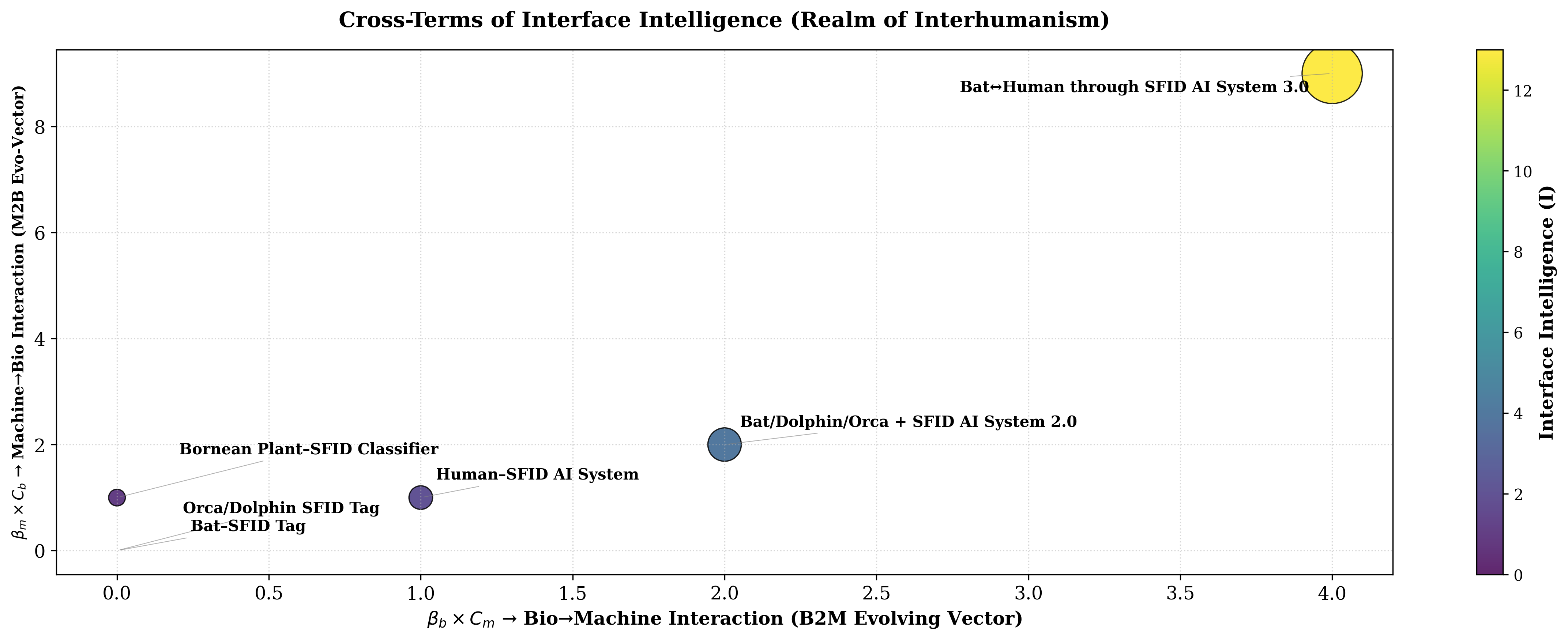
It is possible to assign computational parameters to the symbiont vectors introduced in the dual-symbiont Interface Model. Table 2 presents the scoring of NBII, while Table 3 extends the model toward cybernetic BMII for the quantitative formulation of IIQ to approximate degrees of interconsciousness.
For the numerical assumptions, we provide explicit reasoning for each coefficient and bandwidth parameter: cb, cm, cp, ctm, βp, βb, βm, and βtm. The parameter cb = 1 is assigned for human, since humans possess auditory and linguistic cognition, but lack natural echolocation cognitive process. In contrast, bats, dolphins, and orcas, which exhibit strong echolocation cognitive capability, are assigned cb = 2.
For the Bornean pitcher plant (Nepenthes hemsleyana), we assign cb = cp = 0, as it lacks direct cognitive ability. However, it possesses structural acoustic bandwidth intelligence fidelity, thus βb = βp = 1. For bats, orcas, and dolphins, βb = 1 is maintained because humans can partially perceive their sonic range, and deep-learning-based sound classifiers (machines) can be trained to interpret their echolocation data.
The parameter βm varies from 0 to 3 across sonic frequency identifications (SFID) tags to advanced SFID Transponder AI systems [19], reflecting increasing levels of acoustic and sensory fidelity. Based on these parameters, numerical simulations can be executed to explore interconsciousness as a quantifiable and debatable phenomenon within Interface Intelligence scoring.
What is most fascinating, however, is not the numerical simulation itself, but the revelation that bandwidth plays a crucial role in determining the potential for both transhumanism and posthumanism to coexist within the framework of IIQ theory. Scientists often express concern over the “black box” nature of deep learning models—specifically regarding their internal pattern-recognition mechanisms rather than their inputs, outputs, or logical structure.
The IIQ theory suggests that this “black box” is, in essence, due to information asymmetry related to the communication fidelity and bandwidth capacity that define interface intelligence. Enhancing computational hardware such as GPUs increases cm (the computational capacity of the machine symbiont), while βm may remain constant. Conversely, brain–machine interface devices expand βm, thereby increasing the system’s bandwidth and physical passive memory for information to make the interface more efficient. Or for another instance, Nested-learning algorithms increases the βm.
If humans were to enhance their cognitive abilities biologically (e.g., through genetic modification) without connecting to machines, this would represent an increase in cb while βb remains unchanged. When humans learn additional languages with different letters such as Chinese, Korean, Spanish, Russian, French, or Persian, βb increases because linguistic diversity expands human–machine communication bandwidth. Conversely, sensory impairments such as deafness or blindness decrease βb. A small number of humans can naturally perceive infrasonic or ultrasonic frequencies, leading to an elevated βb.
Similarly, if underdevelopment machines were engineered to perceive olfactory inputs capable of influencing human emotion, βm would increase. This interplay of parameters captures both the beauty and the madness of IIQ theory: it is neither inherently superior nor inferior, but dynamic and distributed. The system can be posthuman when cognition is shared, transhuman when humans are directly involved, or transspecies when biological symbionts such as bats, dolphins, or orcas achieve higher interface intelligence scores than human–machine hybrids. In degenerate cases, interface intelligence may vanish entirely (II = 0), whereas in convergent cases—where transhumanism and transspecies interactions co-emerge—it may be exponentially augmented.
2.6 Quantifying Interconsciousness Model
In IIQ framework, interconsciousness refers to the dynamic overlap of two integrated information fields, Φ, that temporarily form a shared, hybrid Φ field corresponding to the quantity of collective consciousness involved. When such overlaps occur recursively across multiple systems, they generate a scalable, fractal conscious system.
The hierarchical structure of this model can be described as follows:
- Proto-consciousness: minimal integration (Φ > 0) and precursor awareness at the level of a single neuron or agent;
- Consciousness: strong internal integration and awareness within a single biological agent;
- Interconsciousness: bidirectional coupling between agents that produces a shared field of awareness (e.g., human–AI, bat–AI);
- Fractal consciousness: recursive hierarchies of interconscious links forming nested, self-similar structures of consciousness across all scales (from neuron to civilization).
In this hierarchical model, interconsciousness serves as the unit cell of fractal consciousness; fractal consciousness is the infinite recursion of interconsciousness. The topic of consciousness itself lies beyond the primary scope of this paper—these ideas arise as speculative reflections during the quantification of interface intelligences across species or transpecies intelligences.
Speculative example:
Consider a system composed of a bat (a biological consciousness) and an AI (a non-conscious algorithmic system) coupled bidirectionally. The bat’s echolocation signals and brain states influence the AI’s internal models, while the AI’s outputs in turn affect the bat’s actions or sensory inputs.
- The bat alone: conscious.
- The AI alone: not conscious.
- The bat+AI system:
- If the AI merely provides data → not interconscious.
- If the AI modulates the bat’s perception in real time and the bat’s feedback modifies the AI → a proto-conscious hybrid.
- If both maintain continuous, state-dependent mutual influence → an interconscious transpecies system within a fractal consciousness.
we can define the hybrid function as follows,
Φinterface = H(ΦB, ΦM, II) (8)
Φinterface = ΦB + ΦM + wBM (ΔSB · ΔSM) (9)
This expresses the interface integrated information (Φinterface) between system M and B (e.g., AI machine and a biological bat), where:
- ΦB = integrated information of the bat
- ΦM = integrated information of the AI machine
- wBM = coupling weight between them
- ΔSB and ΔSM = state changes in each system
Now, how can we quantify interconsciousness mathematically? The state changes in each system arise from bidirectional causality between the machine symbiont and the biological symbiont. In this case, we model the interaction as ΔSB · ΔSM = II, where II represents the degree of interface intelligence: either the fidelity of the machine symbiont increases, or the biological symbiont adapts more effectively.
The coupling weight, wBM, ranges from 0 (no integration) to 1 (full integration of interface intelligence). If the AI is non-conscious, we assign ΦM = 0, while ΦB remains non-zero for the conscious bat. The interface-level integrated information, Φinterface, will therefore become greater than ΦB for any smallest non-zero value of wBM provided that II is also non-zero.
When Φinterface > max(ΦM, ΦB), the system transitions from individual consciousness to interconsciousness. When the bat falls asleep, its internal causal structure weakens—neural modules decouple during slow-wave phases.
ΦB ↓ (10)
That is, the integrated information of the bat (ΦB) drops toward minimal values. Furthermore,
ΔSB ≈ 0 (11)
indicating that no meaningful new state changes occur within the bat’s neural network. Consequently, the cross-agent interaction term also diminishes:
wBM (ΔSB · ΔSM) → 0 (12)
Thus, the total interface integrated information can be approximated as
Φinterface ≈ ΦM + ΦBsleep (13)
and since
ΦBsleep << ΦBawake (14)
the interface’s overall interconsciousness collapses toward the AI’s baseline integration—still functional, but biologically conscious dependent in phenomenological depth. If we replace ΦB with a Bornea pitcher plant,
Φinterface = ΦP + ΦM + wPM (ΔSP · ΔSM) (15)
Accoding to IIT [44] [45] [46], consciousness corresponds to the amount of integrated information generated by a system’s internal causal structure. Plants do have information processing (e.g., chemical signaling, electrical potentials, networked roots, and light sensors). But these processes are slow, modular, and weakly integrated — not recurrent in the way neuronal loops are. Plants are likely proto-conscious (minimal internal integration), but not conscious in the sentient or subjective sense.
Let us consider an extreme case where ΦP = 0. Suppose a non-conscious AI system such as SFID has learned and integrated behaviors that allow it to locate a pitcher plant and deliver animal feces to it whenever the plant’s reservoir becomes empty. In this scenario, the interface intelligence is defined as II = 1 (according to Table 3), and consequently, Φinterface becomes non-zero. This implies that the system is proto-conscious—not yet conscious, but possessing a higher level of integrated information than the plant alone, for which ΦP = 0.
If we assign a very small, non-zero value to ΦP to represent minimal or proto-conscious integration, then at its most efficient coupling, Φinterface could reach approximately ΦP + wPM, yet it would still remain within the proto-conscious regime since max(wPM) = 1. Therefore, depending on the coupling strength and interaction dynamics, Φinterface can be classified as non-conscious, proto-conscious, or interconscious—occupying a continuum between post-conscious and fractal-conscious states.
2.6.1 Advanced Interconsciousness Modeling
Now, let each symbiotic subsystem X ∈ {M, B, …} be described by a state vector sX(t) ∈ ℝn (or by an appropriate stochastic process). We cand define the state change over a time interval Δt as,
ΔSX ≡ 𝒟(sX(t + Δt), sX(t)) (16)
where 𝒟(·,·) is a chosen norm or distance function (e.g., the Euclidean norm of state differences, the Kullback–Leibler divergence for probability distributions, or the magnitude of change within a feature space).
We can define an interaction information term integrated through interface intelligence:
IIMB ≡ 𝕀(ΔSM, ΔSB) (17)
where 𝕀 represents a measure of statistical or causal interaction—such as normalized mutual information at interface, or a causal metric defined as the product of directional transfer entropies:
𝕀causal = TEM → B · TEB → M (18)
We introduce coupling weights wMB, wBM ∈ [0,1] that quantify the degree to which subsystem M influences B, and vice versa. The integrated information of the interface (a two-actor system) is then modeled as,
Φinterface = ΦM + ΦB + α(wMB wBM) 𝕀(ΔSM, ΔSB) (19)
where ΦX denotes the internal integrated information of subsystem X as a symbiont (as defined in IIT), and α(·) is a normalization function (e.g., α(u) = u or α(u) = u / (u + u0)) chosen to maintain consistent and bounded units. Then, we can define the following criteria for interoperational conditions:
-
Bidirectional causality: Both directional causal flows must be significant:
TEM → B > θTE, TEB → M > θTE (20)
-
Interface amplification: The interface must exhibit greater integrated information than either individual subsystem:
Φinterface > max(ΦM, ΦB) + ε (21)
where ε > 0 is a small safety margin.
-
Classification by magnitude: we choose thresholds such that
θ0 < θproto < θconscious < θmeta < θfractal (22)
then classify the system as follows:
3. Results and Discussion
3.1 Debate in Realm of Interhumanism
At high levels of feedback fidelity — such as neural interfaces, adaptive multimodal AI, or acoustic cybernetic systems — the human and AI form a coupled cognitive organism. This creates what we may term interconscious possibility or interconsciousness: a distributed awareness across biological and artificial substrates similar to musical improvisation happens between a rhythm guitarist and a lead guitarist shredding in a music band. Rather than asking whether AI thinks, interconsciousness suggests asking how cognition migrates and stabilizes within the interface itself. Human may augment the interface intelligence system through posthumanism route indirectly or through transhumanism route directly and that’s why it is called interhumanism to compare in the following Table 4 with anthropocentrism, transhumanism, and posthumanism.
3.2 Dilemma for Intuitive Mechanism
IIQ theory reframes neural network “black-box” as an expanding shared epistemic membrane between species of intelligence. Interpretability does not depend on transparency within the model, but on the communicative fidelity between the human responses (e.g. bioacoustic muscle memory layer of guitarist's hand and neuromorphic brain interface layer of auditory cortex) and the metasonic AI system. When the fidelity bandwidth deepens — through linguistic, emotional, or neural synchronization — the combined system displays emergent creative and analytic capacity beyond either component alone. The bandwidth of fidelity of human is narrower and increasing slower between human and AI now causing information asymmetry to interpret the black-box phase for human to decode and understand the mechanism. And we see two AI agents communicate with each other better because their bandwidth fidelity is bigger and more efficient than human-machine. If human reach higher bandwidth fidelity than AI, then maybe the black-box became opened box by understanding more internal mechanism. That’s the imagination initiative which caused IIQ position itself in fidelity bandwidth in relationship with black-box problem.
The IIQ is ripe for debate, there are many plausible to hammer it, but it is developed through dummy simplification holistically that can be more straightforward to understand what interhumanism looks like and how we can measure interface intelligence level with applied math and scoring quantitatively thorough computational modeling of eigen values of posthumanism evolving vector and tranhumanism evolving vector.
3.3 Agents On Computer Siumations
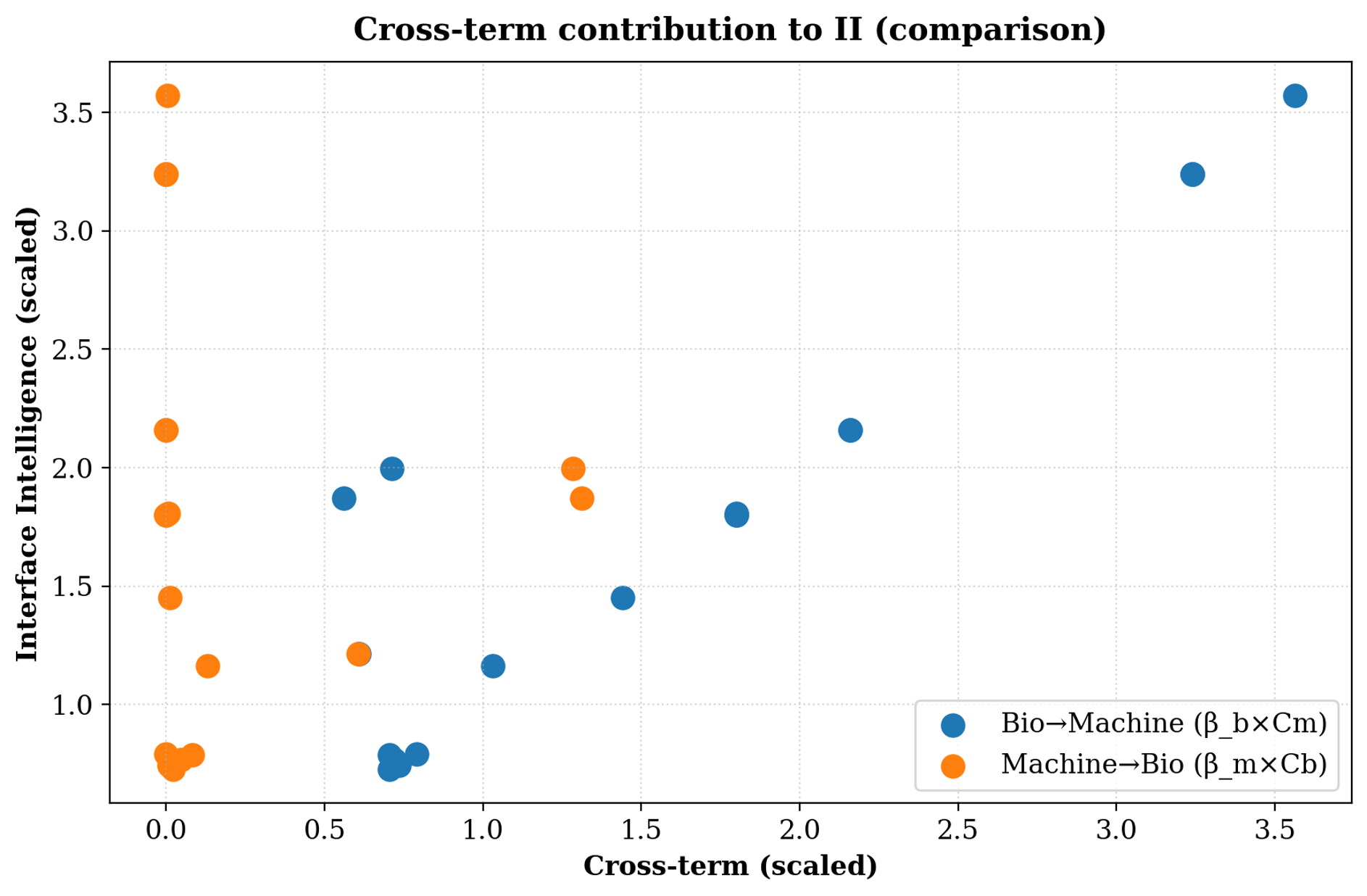
The multi-modal AI agents were used to create the computer simulation environment for interface intelligence with IIQ computational model developed under human supervision. The first computer simulation was performed for interpretation and visualization of cross-terms comparison for interface intelligence scoring for interhumanism accounting the effect of both posthumanism (M2B evolving vector) and transhumanism/transspecies (B2M evolving vector) shown in Figure 1. The simulation result shows that there is possibilities that transpecies outsmarting tranhumans with B2M vector magnitude. The result also shows that tranhumans/transpecies (Bat-human-SFID) noticeably have more interface intelligence intensity and has both B2M and M2B vectors magnitude.
3.4 Extension of IIQ Theory for Transhumanism Behavioral Economics and Venture Simulations Application
IIQ is not just a theory or computer simulations, it can be extended as a quantitative metric intelligence model for financial analysis to measure interface intelligences for application in corporate leadership and managements in AI investments strategies. We can also measure a new metric for AI augmentations in AI companies to account for investments. We live in a behavioral economy and AI advancements are changing the behavior of every individual or entity; a 5% improvement on LLM model between rival AI companies like OpenAI and Anthropic can change the behavior of clients for avalanche of premium subscription cancellations and revenue decline; or even rival chinese AI companies like DeepSeek or Kimi reverse-engineered American LLM models and proposing higher scored models with open-weights or open-source as an innovative method for corporate espionage for competition in market and geopolitics polarization between China and America.
Plus, with considering extreme vision and opinions, transhumanism is the phase between human and posthumanism era. In contrast, the definition of interhumanism is era where human and non-human species are transpeices-symbionts living with machine symbionts forming higher resilient interface intelligence and hybrid civilization that human will reach and face in future. So human investors should invest more intelligently with computer simulations and financial forecast for AI and biorobotics companies they invest in.
Quantitative behavioral finance works on modeling phenomena when investors behave irrationally, but with IIQ computer simulations they will be nudged[47] to take accounts more metrics input to behave less irrational and mitigate risks; similar to nudge theory classic example for flies to reduce cost of cleaning in men's toilet. IIQ can be used as a computer model in venture simulations interacting with AI agents, real data, behavioral economics, and computational finance.
If IIQ is used as one of metrics among other financial ratios [48] [49] [50] and impact weighting accounting [51] metrics by professional investors, governments or corporate policy makers, then AI investments and stock market and AI augmentations investments strategies can be measured in multi-modal large language model booming token economy. For example, we went for the IIQ extended simulation to see how it can be used in computational behavioral finance for investments strategies and decision making rationally. To extend, Table 5 in supporting information for AI companies and their biological and AI machine cognitive abilities.
Benchmarking & Sensitivity Analysis
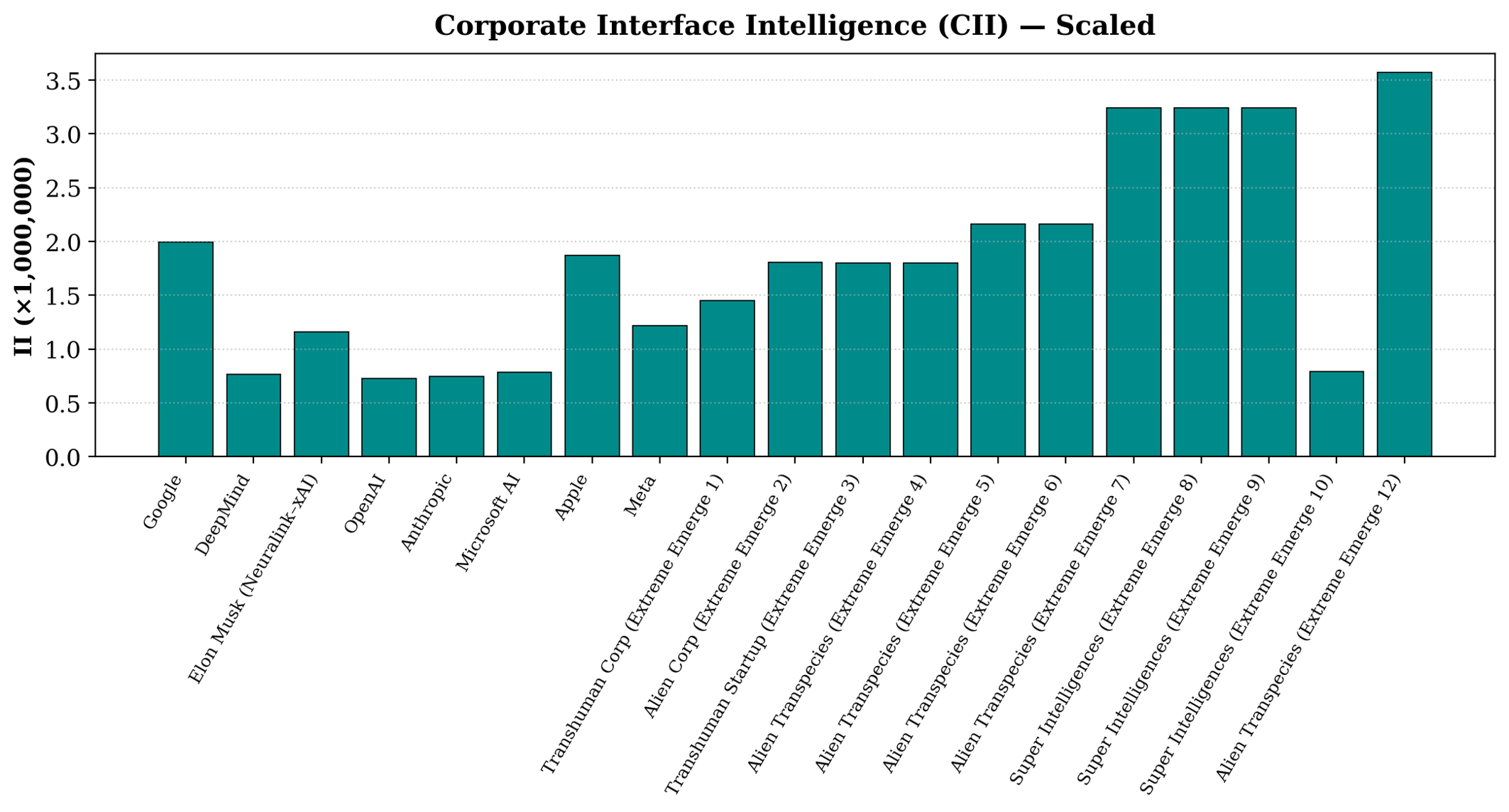
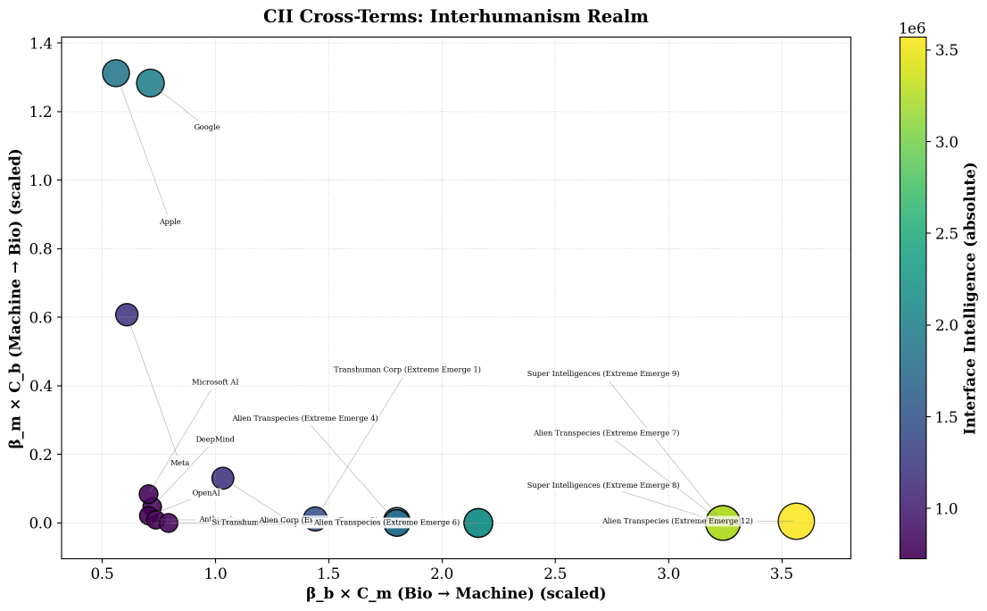
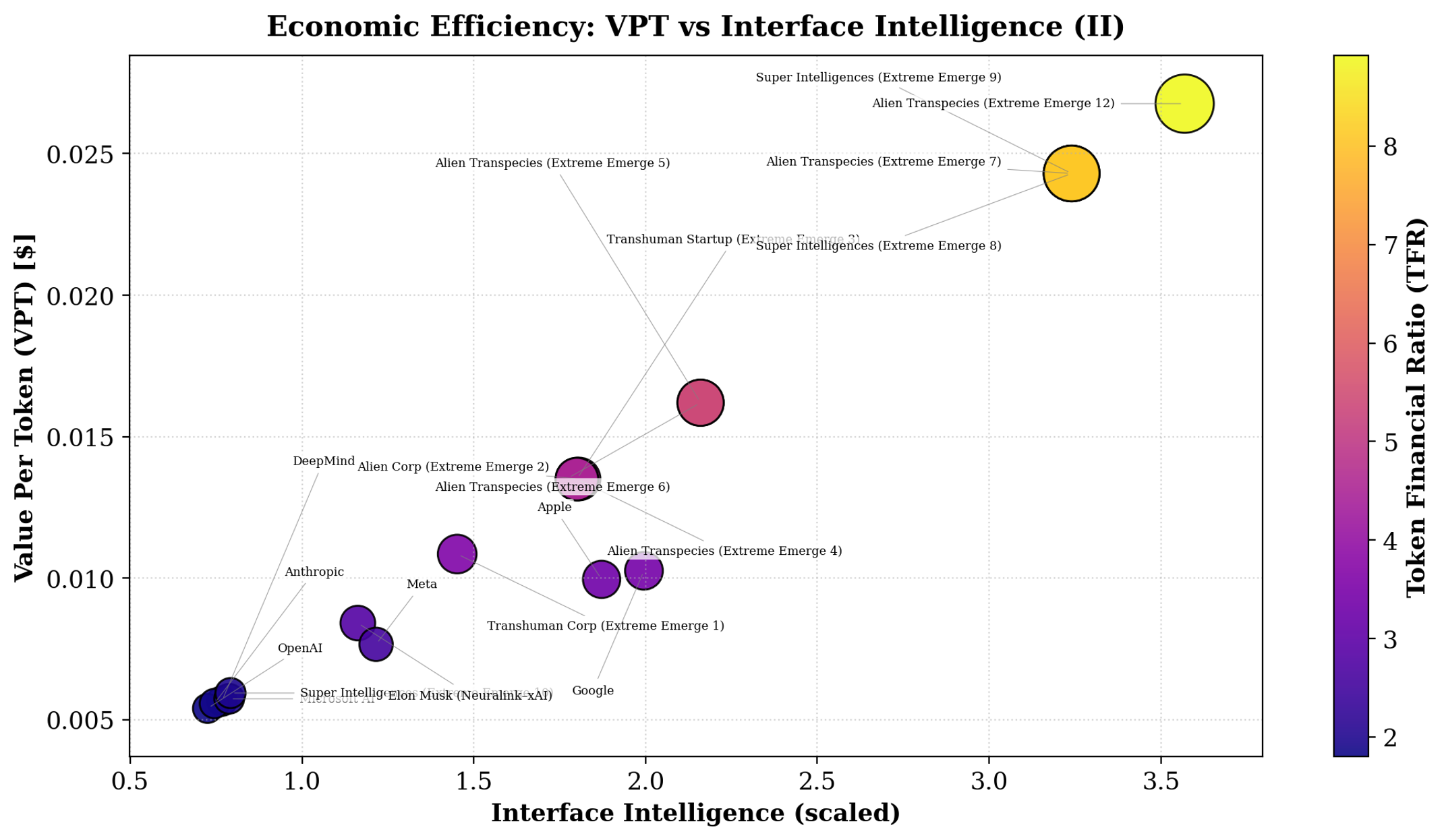
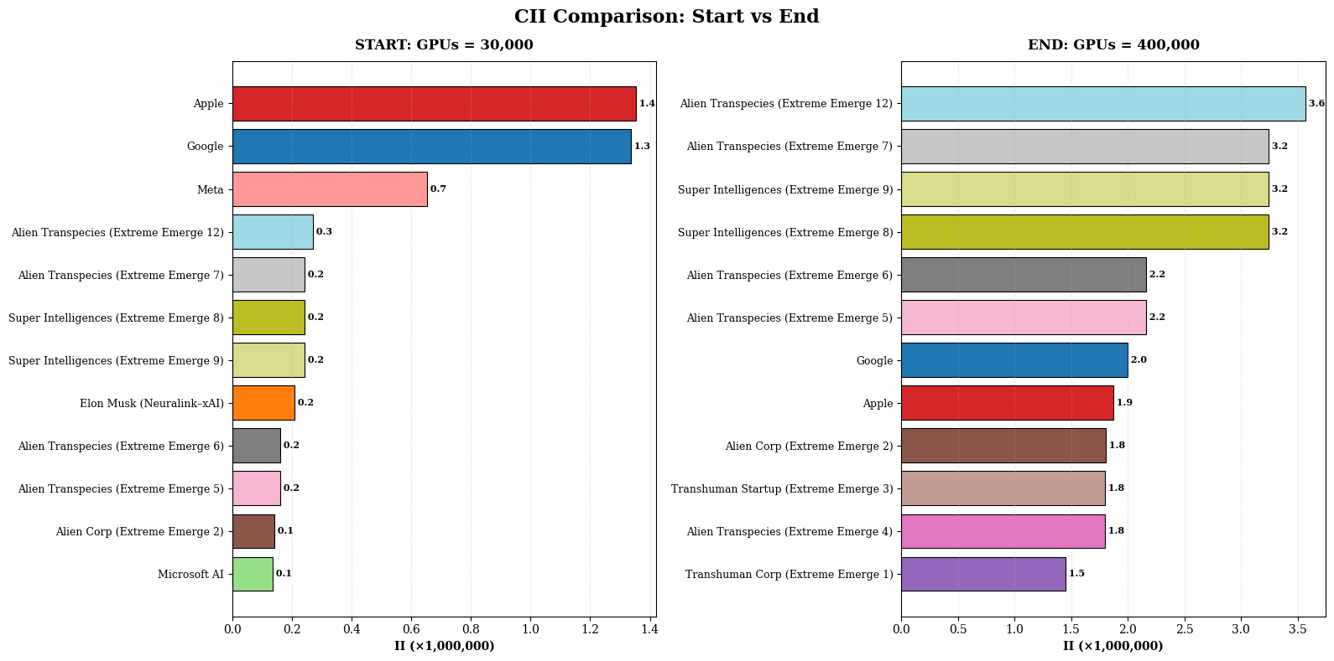
Dynamic IIQ computer simulations can provides more insight for sensitivity analysis for different interplaying parameters in interface intelligence. Video S1 and Video S2 are provided in GitHub repo to see the illuminating power of computer simulation to benchmark intensity of interface intelligence shown in Figure 2 for AI corporations as a dependent variable shown in Figure 3 to extend for financial metrics and valuations ranking in IIQ theory.
Token Valuation & Financial Ratio
Every AI company began working on large language models (LLM) foundations in a token economy. The token input and output has different cost for them and users. On one hand, the AI models with more inaccuracies will push users to explain with more tokens in prompt and more frequecies. This will increase the cost and reduce cost efficiency of the AI company. On the other hand, the more smarter model with less errors, reduce the cost and increase the efficiency. This means that the value of that AI company per less token and less energy use will be higher to reduce burning rate. In addition, the smarter the models are, the more interface intelligence intensity will contribute to that company. Therefore, we define a new token term as company's value per token (VPT).
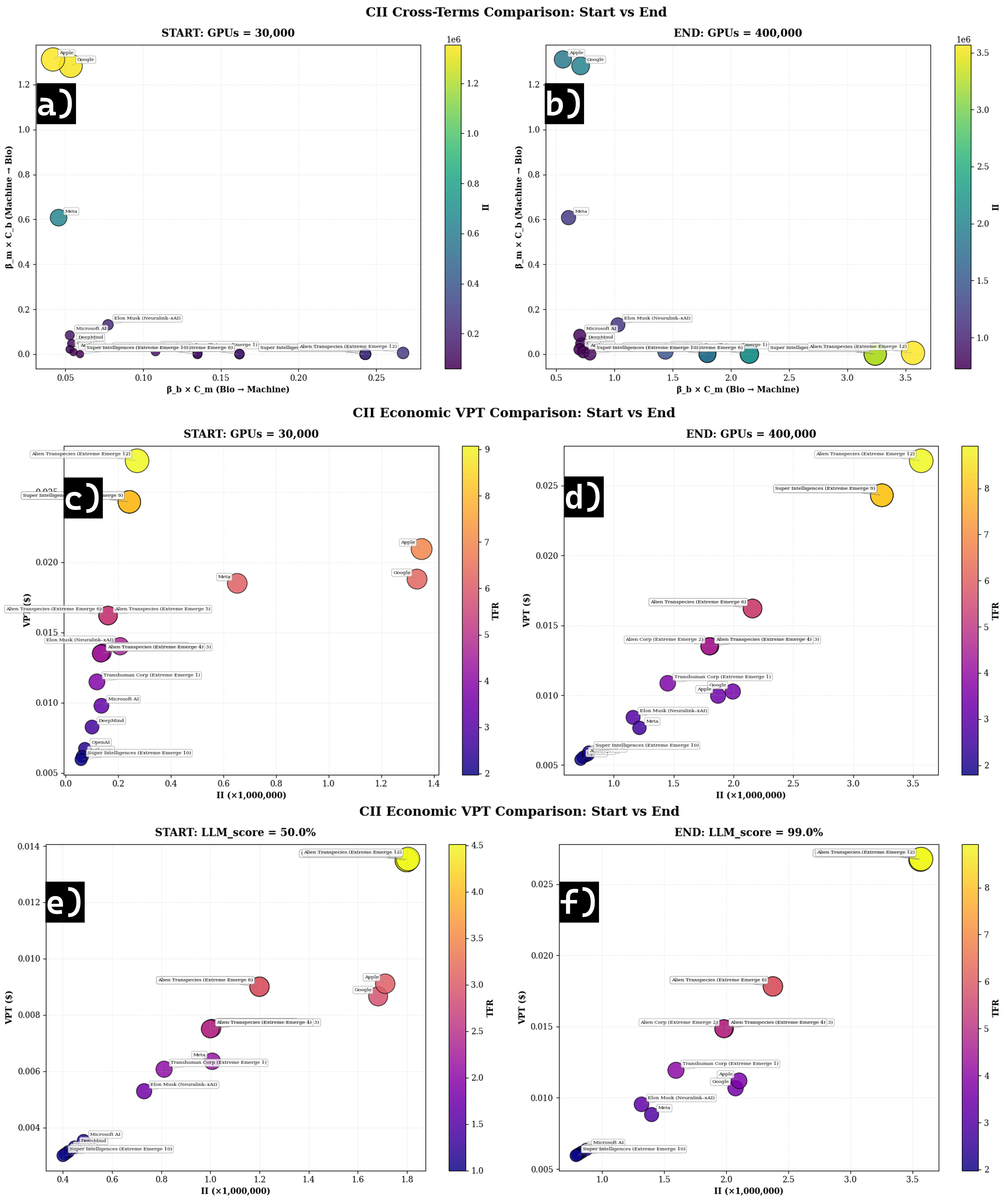
The VPT is calculated based on token cost economy (TCE) parameters and corporate interface intelligence (CII) demonstrated statistically in Figure 4 for one venture simulation. The interface intelligence is also quantize based on cb, βb, and cm βm. For CII, the cb is modeled with numbers of biological cognitive abilities such as number of employees of that AI company. βb is modeled with biological modalities of communication fidelity such as abilities like human visions, olfactory sensing, human auditory sensors, linguistics, brain interface machine developments. Therefore for companies like Neurolink, the βb = 3 is considered in simulation setup and for other human corporations without brain interface machines, the βb = 2 is considered.
For corporate machines, βm can be more modalities such as text, images, sounds, brain interface machine, transponders, infrared camera, piezoelectric, etc. Thus, for computer simulation, we considered βm = 7 as a based line parameter setup. And finally for cm we can assume number of GPU units available multiplied by LLM model score the AI company possess. The TCE for all AI companies is based on AI model efficiency, we assumed same as for AI companies for this simulation setup around $0.003. Table 5 in appendix is provided to summarize parameters for CII Simulation with taking accounts for the following equations.
cm_c = corporate GPUs × cognitive score (24)
VPT($) = TCE ($) GPUs + cb_c (25)
- cb_c = number of corporate employees
- βb_c = corporate biological fidelity
- βb_m = corporate machine fidelity
Interpretations for Investor's Behavior
IIQ theory computer simulations interpretations are interesting in behavioral finance for investors. Venture simulations and benchmarking shows companies with potential of superintelligences and alien transpecies wil be the highest of chain in interhumanism realm. For example, interface intelligent corporations like Neurolink-xAI have strong tranhuman and posthuman vectors growing in future with higher valuations and more interface intelligence potentials.
The superintelligences companies are ranked and score high as well. Computer simulations results shows alien transpecies intelligences will slightly have superior power over superintelligences based on IIQ theory principles and interplaying parameters. For example, corporate cognitive capacity of machines, compared across different terms as illustrated in Figure 5, significantly influences the results; specifically, changes in GPU units – ranging from 30,000 to 400,000 – are shown in Figure 6 and Video S1 and demonstrably affect CII in Figure 7a,b and Video S2; VPT in Figure 7c,d and Video S3; TFR in Figure 7e,f; and animated changes to LLM scores, visualized in Videos S4, are visualized for investor analysis.
a Nudge for Algorithmic Trade
IIQ metrics such as II, VPT, TFR can also effect alogrithm and decision making like a nudge [52] [47] for human and bias of bots in stockmarket for investments. This might have positive and negative impact on investments, and bots can score AI companies vision based on intelligence, token and valuations in a portolio next to each other for automations or visually analyze for stock broker or corporate investors.
Future Works on Interface Intelligences
IIQ can be modeled with better logic and mathematical improvement in future to introduce more metrics and better visualizations in computer simulations. IIQ is also proving insight on which evolving vectors the artificial intelligence and neural biotechnology can augment human into posthumanism or transhumanism/transpecies direction find new communicaiton fidalities like SFID-tags and SFID AI systems 2.0 or 3.0 or brain interface machines.
Warning Possibilities
Based on IIQ computer simulations and its dynamic quantitative logics, transparencies and posthumanism superintelligences are warnining possibilites that is not remote to develop within next decades. Between transpecies and superintelligences, the metasonic transpecies will be way more dangerous to human if they become able to attached to superintelligence symbiotically. For example, on paper and computer simulations results, SFID AI system 2.0 and 3.0 will enable transpecies emergences dominant human intelligence. In the extreme cases, controlling interface intelligence will be become symbiotically decentralized, or asymbiotic, not hierarchical.
| Aspect | Natural Interface Intelligence | Cybernetic Interface Intelligence |
|---|---|---|
| Interface Entity | N. hemsleyana plant provides an echo-responsive surface bandwidth βp tuned to bat sonar and cognitive capability cb. | Machine symbiont cm provides structured, interpretable feedback through bandwidth βb (text, image, voice, data, language, signals). |
| Reciprocal Cognition | K. hardwickii bat’s ear βb receives its echolocation frequency to match the plant’s resonance and reverberation cognitive enhancement ability cb. | Human brain cb adapts cognition, emotion, or perception to machine feedback loops and machine bandwidth βm (text, image, voice, data, language, signals). |
| Interface Signal | The acoustic signal is the interface enabling shared survival performance. | The digital cognitive signal is the interface enabling shared intelligence. |
| Distributed Intelligence | Symbiotic intelligence augmented and distributed across biological species. | Transpecies intelligence augmented and distributed across biological and artificial agents. |
| Aspect | Species | Cb | βb | Cp, Ctm | βp, βtm | II |
|---|---|---|---|---|---|---|
| 1 | Bornean Bat – Pitcher Plant | 1 | 1 | 0 | 1 | 1 |
| 2 | Tiger Moth Jamming Bat | 1 | 1 | 1 | 1 | 2 |
| 3 | Bat Feeding on Pollens | 1 | 1 | 0 | 1 | 1 |
| 4 | Other Bats | 1 | 1 | 0 | 0 | 0 |
| 5 | Other Carnivorous Plants | 0 | 0 | 0 | 0 | 0 |
| 6 | Dancing Plant | 0 | 0 | 0 | 1 | 0 |
| Aspect | Bio-Symbiont | Machine | cb | βb | cm | βm | II | Interconscious |
|---|---|---|---|---|---|---|---|---|
| 1 | Human | SFID AI System | 1 | 1 | 1 | 1 | 2 | Likely conscious (human mediated) |
| 2 | Dolphin/Orca | SFID-tag | 2 | 2 | 0 | 0 | 0 | Non-conscious interface (animal itself conscious) |
| 3 | Bat | SFID-tag | 2 | 2 | 0 | 0 | 0 | Non-conscious interface (animal itself conscious) |
| 4 | Bornean Pitcher Plant | SFID Classifier (trained on Plant) | 0 | 1 | 1 | 1 | 1 | non-conscious / proto |
| 5 | Bat/Dolphin/Orca | SFID AI System 2.0 | 2 | 2 | 1 | 1 | 4 | interface-enabled (animal–AI transpecies) |
| 6 | SFID-tag Bat ↔ Bornean Plant attached to Human | SFID AI System 3.0 | 3 | 2 | 2 | 3 | 13 | multi-agent interconscious (emergent) |
| Aspect | Anthropocentrism | Transhumanism | Posthumanism and Posthuman Singularity | Interhumanism |
|---|---|---|---|---|
| Core Definition | Human beings are the central and most significant entities in the universe. | Humans use technology to enhance physical and cognitive capacities beyond biological limits. | Challenges human centrality, emphasizing hybrid, networked, and ecological forms of being. The possibility of extraterrestrial life and fractal scale intelligence. Unlimited scales of superintelligence, & singularity. | Closer to posthumanism AI singularity view, but interface intelligence can be affected by tranhumanism view as well. Scale determines the mutual bandwidth and affects fidelity of interface intelligence. |
| Ontology | Human-centered reality. | Human identity extended through technology. | Distributed and relational; human, machine, and environment co-constitute existence. | Interface-centered ontology: distrubted intelligence is not always dominant, or not located within either entity. Asymbiosis can outsmart symbiosis. |
| Goal | Preserve human dominance. | Achieve post-biological evolution. | Deconstruct human exceptionalism; recognize non-human agency. | Symbiotic cognitive and co-adaptation between human and AI through interface performance. |
| View of Technology | Subordinate instrument and tool. | Vehicle for enhancement and transcendence. | Co-agent in hybrid ecologies of intelligence. | Symbionts are fidelity tools for AI |
| View of Intelligence | Exclusive to humans. | Enhanced human cognition. | Distributed across human and non-human systems. | Symbiotic Human. Asymbiotic interface where symbionts are options. |
| Agency | Human sole agent, | Human augmented agent, | Multi-agent network. | Augmented symbionts in a multi-agent network. |
| Fidelity Mode | human to human cognitive communications, fast learning methods, nature and nurture. | Increased human bandwidth through technological augmentation like brain-interface machines. | Expanded bandwidth through cultural and ecological adaptation. | Dual-Symbiont Interface Vectors: (1) Machine-To-Bio evolving vector bandwidth in posthumanim; (2) Human-to-Machine evolving vector for transhumanism. |
| Relation to AI | AI as servant. | AI as extension of human will. | AI as partner in distributed cognition. | AI as co-cognitive symbiont. |
| Ethical Focus | Maintain human superiority. | Preserve individuality while transcending biology. | Include all forms of cognition in ethical frameworks. | Possibilites of Bat cyborg outsmarting human cyborg |
| Representative Thinkers | Descartes, Kant | Garreau, Bostrom, Kurzweil | Heidegger, Fernando, Kurzweil,Haraway, Hayles, Latour | Saatchi speculated on Kurzweil, Haraway, Wiener, Hinton |
| Metaphor | Human as ruler | Human as cyborg | Human as network node | Human as a symbiotic fidelity vector |
| Company | Cb | Bb | Cm | Bm | II | GPUs | LLM Score (%) | TCE ($) | VPT ($) | TFR |
|---|---|---|---|---|---|---|---|---|---|---|
| 183,323 | 2 | 356,000 | 7 | 1,995,261 | 400,000 | 89 | 0.003 | 0.010 | 3 | |
| DeepMind | 6,724 | 2 | 360,000 | 7 | 767,068 | 400,000 | 90 | 0.003 | 0.006 | 2 |
| Elon Musk (Neurolink, xAI, Grok, Starlink) | 14,500 | 3 | 344,000 | 9 | 1,162,500 | 400,000 | 86 | 0.003 | 0.008 | 3 |
| OpenAI | 3,000 | 2 | 352,000 | 7 | 725,000 | 400,000 | 88 | 0.003 | 0.005 | 2 |
| Anthropic | 1,300 | 2 | 368,000 | 7 | 745,100 | 400,000 | 92 | 0.003 | 0.006 | 2 |
| Microsoft AI | 12,000 | 2 | 352,000 | 7 | 788,000 | 400,000 | 88 | 0.003 | 0.006 | 2 |
| Apple | 164,000 | 2 | 280,000 | 8 | 1,872,000 | 400,000 | 70 | 0.003 | 0.010 | 3 |
| Meta | 75,945 | 2 | 304,000 | 8 | 1,215,560 | 400,000 | 76 | 0.003 | 0.008 | 3 |
| Transhuman Corporation (Extreme Emerge 1) | 1,300 | 4 | 360,000 | 9 | 1,451,700 | 400,000 | 90 | 0.003 | 0.011 | 4 |
| Alien Corporation (Extreme Emerge 2) | 1,300 | 5 | 360,000 | 5 | 1,806,500 | 400,000 | 90 | 0.003 | 0.014 | 5 |
| Transhuman Startup (Extreme Emerge 3) | 2 | 5 | 360,000 | 7 | 1,800,014 | 400,000 | 90 | 0.003 | 0.014 | 5 |
| Alien transpecies (Extreme Emerge 4) | 1 | 5 | 360,000 | 5 | 1,800,005 | 400,000 | 90 | 0.003 | 0.014 | 5 |
| Alien transpeices (Extreme Emerge 5) | 1 | 6 | 360,000 | 5 | 2,160,005 | 400,000 | 90 | 0.003 | 0.016 | 5 |
| Alien transpeices (Extreme Emerge 6) | 1 | 6 | 360,000 | 9 | 2,160,009 | 400,000 | 90 | 0.003 | 0.016 | 5 |
| Alien transpeices (Extreme Emerge 7) | 1 | 9 | 360,000 | 9 | 3,240,009 | 400,000 | 90 | 0.003 | 0.024 | 8 |
| Super Intelligences (Extreme Emerge 8) | 0 | 9 | 360,000 | 9 | 3,240,000 | 400,000 | 90 | 0.003 | 0.024 | 8 |
| Super Intelligences (Extreme Emerge 9) | 0 | 9 | 360,000 | 1,000 | 3,240,000 | 400,000 | 90 | 0.003 | 0.024 | 8 |
| Super Intelligences (Extreme Emerge 10) | 0 | 2 | 396,000 | 5,000 | 792,000 | 400,000 | 99 | 0.003 | 0.006 | 2 |
| Super Intelligences (Extreme Emerge 11) | 0 | 9 | 396,000 | 5,000 | 3,564,000 | 400,000 | 99 | 0.003 | 0.027 | 9 |
| Alien transpeices (Extreme Emerge 12) | 1 | 9 | 396,000 | 5,000 | 3,569,000 | 400,000 | 99 | 0.003 | 0.027 | 9 |
4. Conclusion
Metasonic brain interface intelligence quantitative theory defines a new epoch in human–AI hybrid evolution. As interfaces become richer — neural, sensory, and generative — intelligence shifts from an internal property to an ecological relation. Future research may quantify communication fidelity better as a measurable cognitive interface variable, enabling comparative models of human–AI coupling strength. Ultimately, intelligence may prove to be less about who thinks, and more about how well we communicate in the most adaptive intelligent interface above inferiors ones. The first thing is noticeable in this theory is measuring interface intelligence is indeed a vector based scoring, intelligence augmentations can be augmented in different directions in interhumanism for posthumanism, and transhumanism/transpecies. The human is part of posthumanism influencing directly or indirectly by building AI machines augmenting human or even non-human. The human is also not at the center in interhumanism because of posthumanism decentralize force, and there is probability to be be outsmarted by emerging transpecies or maybe chimera augmentations. The bottleneck is communication fidelity and symbiotic bandwidth. It’s harder to increase it, but one degree of increase will change the interface intelligence significantly. In the long term, control will become symbiotically distributed, or asymbiotic, not hierarchical. Finally, the IIQ theory is extended for computer simulations and AI ventures simulations for behavioral finance application and future of AI-Biorobotic companies.
Supporting Information
Supporting Information is available in appendix, on GitHub or from the author.References
- G. Hinton, "Deep learning—a technology with the potential to transform AI," Nature, vol. 556, pp. 419–420, 2018. doi: 10.1038/d41586-018-04546-0
- D. Engelbart, "Augmenting human intellect: A conceptual framework," Stanford Research Institute, 1962.
- D. Haraway, Simians, Cyborgs, and Women: The Reinvention of Nature, Routledge, 1991.
- J. Garreau, Radical Evolution: The Promise and Peril of Enhancing Our Minds, Our Bodies—and What It Means to Be Human. New York, NY, USA: Doubleday, 2005.
- R. Kurzweil, The Singularity Is Near: When Humans Transcend Biology. New York, NY, USA: Viking, 2005.
- M. Heidegger, "The Question Concerning Technology," in The Question Concerning Technology and Other Essays, W. Lovitt, Trans., New York, NY, USA: Harper & Row, pp. 3–35, 1977.
- D. Banerji, F. Ferrando, S. Rozzoni, and J. Pascoe, "Beyond Theory: A Mythical Journey Towards Posthumanist Ethix," Technologies of the Future Self, pp. 193–218, 2025. doi: 10.1007/978-3-031-99902-4_8
- F. Ferrando, S. Buran, and S. Rozzoni, "Multilogue on Post-violence: Posthumanist Visions, Narratives and Entanglements," Entanglements in the Age of the Posthuman, p. 29, 2025.
- S. Rozzoni and F. Ferrando, "Images of the Human Being: Posthumanism," Encyclopedia of the Anthropocene, pp. 1–5, 2026. doi: 10.1007/978-3-031-58753-4_93
- F. Ferrando, Philosophical Posthumanism. London, UK: Bloomsbury Academic, 2019. doi: 10.5040/9781350059511
- N. K. Hayles, How We Became Posthuman: Virtual Bodies in Cybernetics, Literature, and Informatics. Chicago, IL, USA: University of Chicago Press, 1999. doi: 10.7208/chicago/9780226321394
- G. Tononi, "An information integration theory of consciousness," BMC Neuroscience, vol. 5, p. 42, 2004. doi: 10.1186/1471-2202-5-42
- T. F. Varley, R. Carhart-Harris, D. S. Roseman, L. Menon, and A. L. Stamatakis, "Fractal dimension of cortical functional connectivity networks and severity of disorders of consciousness," PLoS ONE, vol. 15, no. 11, e0223812, 2020. doi: 10.1371/journal.pone.0223812
- B. Gardiner, "Fractals and the irreducibility of consciousness in plants and animals," Philosophy, Cosmology and Evolution, vol. 13, pp. 26–37, 2013. doi: 10.4161/psb.25296
- E. Bieberich, "Introduction to the fractality principle of consciousness and the sentyon postulate," Biologically Inspired Cognitive Architectures, vol. 5, pp. 41–49, 2013. doi: 10.1007/s12559-011-9104-5
- I. Bugarski, "Fractal Thoughts and the Emergent Self: A Categorical Model of Consciousness as a Universal Property," PhilArchive, 2019. Available: https://philarchive.org/archive/BUGFTA
- R. Balestriero and Y. LeCun, "LeJEPA: Provable and Scalable Self-Supervised Learning Without the Heuristics," arXiv preprint arXiv:2511.08544, 2025. doi: 10.48550/arXiv.2511.08544
- E. Dalmas, F. Danneville, F. Elbahhar, M. Bocquet, and C. Loyez, "A review of neuromorphic sound source localization and echolocation-based navigation systems," Electronics, vol. 13, no. 24, Art. 4858, 2024. doi: 10.3390/electronics13244858
- D. Saatchi, M.-J. Lee, T. P. Pandit, M. Mahato, and I. K. Oh, "Artificial intelligence in metamaterial informatics for sonic frequency mechanical identification tags," Advanced Functional Materials, vol. 35, no. 10, article 2414670, 2025. doi: 10.1002/adfm.202414670
- E. Musk and Neuralink, "An Integrated Brain-Machine Interface Platform With Thousands of Channels," Journal of Medical Internet Research, vol. 21, no. 10, e16194, 2019. doi: 10.2196/16194
- A. Lavazza, M. Balconi, M. Ienca, F. Minerva, F. G. Pizzetti, M. Reichlin, F. Samorè, V. A. Sironi, M. Sosa Navarro, and S. Songhorian, "Neuralink’s brain computer interfaces: medical innovations and ethical challenges," Frontiers in Human Dynamics, vol. 7, 2025. doi: 10.3389/fhumd.2025.1553905
- C. E. Boklage, How New Humans Are Made: Cells and Embryos, Twins and Chimeras, Left and Right, Mind/Self/Soul, Sex, and Schizophrenia. Singapore: World Scientific, 2010, 516 pp. doi: 10.1142/7034
- V. Papaioannou and R. Johnson, "Production of chimeras by blastocyst and morula injection of targeted ES cells," pp. 133–173, 1999. doi: 10.1093/oso/9780199637928.003.0008
- M. L. Belgovskii, "The causes of mosaicism associated with heterochromatic chromosome regions," Journal of General Biology, vol. 5, no. 6, pp. 325–356, 1944. Translated edition, 1962, OTS 61-11476.
- S. Taddeo and J. S. Robert, "Hybrids and chimeras: A consultation on the ethical and social implications of creating human/animal embryos in research (2007), by the HFEA," The Embryo Project, Arizona State University, Nov. 4, 2014.
- Z. Bayraktar, "Potential autofertility in true hermaphrodites," The Journal of Maternal-Fetal & Neonatal Medicine, vol. 31, no. 4, pp. 542–547, 2018. doi: 10.1080/14767058.2017.1291619. PMID: 28282768. S2CID: 22100505.
- C. C. Bowley, A. M. Hutchison, J. S. Thompson, and R. Sanger, "A human blood-group chimera," British Medical Journal, vol. 2, no. 4827, p. 81, 1953. doi: 10.1136/bmj.2.4827.81. PMCID: PMC2028470. PMID: 13051584.
- H. Wolinsky, "A mythical beast: Increased attention highlights the hidden wonders of chimeras," EMBO Reports, vol. 8, no. 3, pp. 212–214, 2007. doi: 10.1038/sj.embor.7400918. PMCID: PMC1808039. PMID: 17330063.
- K. Madan, "Natural human chimeras: A review," European Journal of Medical Genetics, vol. 63, no. 9, article no. 103971, 2020. doi: 10.1016/j.ejmg.2020.103971. PMID: 32565253.
- N. Glade, P. Ballet, and O. Bastien, "A stochastic process approach of the Drake equation parameters," International Journal of Astrobiology, vol. 11, no. 2, pp. 103–108, 2012. arXiv:1112.1506. doi: 10.1017/S1473550411000413
- A. Cassan et al., "One or more bound planets per Milky Way star from microlensing observations," Nature, vol. 481, no. 7380, pp. 167–169, 2012. arXiv:1202.0903. doi: 10.1038/nature10684
- A. Frank and W. T. Sullivan III, "A new empirical constraint on the prevalence of technological species in the universe," Astrobiology, vol. 16, no. 5, pp. 359–362, 2016. arXiv:1510.08837. doi: 10.1089/ast.2015.1418
- D. Forgan, "A numerical testbed for hypotheses of extraterrestrial life and intelligence," International Journal of Astrobiology, vol. 8, no. 2, pp. 121–131, 2009. arXiv:0810.2222. doi: 10.1017/S1473550408004321
- C. Maccone, "The Statistical Drake Equation," Acta Astronautica, vol. 67, no. 11–12, pp. 1366–1383, 2010. doi: 10.1016/j.actaastro.2010.05.003
- Z. Hetesi and Z. Regaly, "A new interpretation of Drake equation," Journal of the British Interplanetary Society, vol. 59, pp. 11–14, 2006.
- L. M. Golden, "A joint mind consideration of the Drake equation in the search for extraterrestrial intelligence," Acta Astronautica, vol. 185, pp. 333–336, 2021. doi: 10.1016/j.actaastro.2021.03.020
- G. D. Brin, "The Great Silence – The Controversy Concerning Extraterrestrial Intelligent Life," Quarterly Journal of the Royal Astronomical Society, vol. 24, no. 3, pp. 283–309, 1983.
- J. Tarter, "Hello... Is there anybody out there?," Science Friday, 2013. Available: https://www.sciencefriday.com/segments/hello-is-there-anybody-out-there/
- P. McMillen and M. Levin, "Collective intelligence: A unifying concept for integrating biology across scales and substrates," Communications Biology, vol. 7, art. no. 378, 2024. doi: 10.1038/s42003-024-06037-4
- D. Saatchi, M.-J. Lee, T. P. Pandit, M. Mahato, and I. K. Oh, "Artificial intelligence in metamaterial informatics for sonic frequency mechanical identification tags," Advanced Functional Materials, vol. 35, no. 10, article 2414670, 2025. doi: 10.1002/adfm.202414670.
- M. G. Schöner, C. R. Schöner, R. Simon, T. U. Grafe, S. J. Puechmaille, L. L. Ji, G. Wibbelt, S. Zhang, and G. Kerth, "A mutualistic relationship between a carnivorous plant and a bat," Nature Communications, vol. 6, article 7612, 2015. doi: 10.1038/ncomms8612.
- M. G. Schöner, R. Simon, and C. R. Schöner, "Acoustic communication in bat–plant interactions," Current Biology, vol. 27, no. 17, pp. R888–R890, 2017. doi: 10.1016/j.cub.2017.07.046.
- M. G. Schöner, G. Kerth, and C. R. Schöner, "The role of acoustic cues in bat–plant mutualisms," Behavioral Ecology and Sociobiology, vol. 72, no. 7, p. 107, 2018. doi: 10.1007/s00265-018-2526-7.
- J. W. Schooler, M. Baird, and M. Mrazek, "Metaconsciousness and mind wandering: Re-representation of experience," in Cognition and Mind: Meta Models, J. Schooler et al., Eds., pp. 85–102, 2015.
- D. J. Chalmers, "The meta-problem of consciousness," Journal of Consciousness Studies, vol. 25, no. 9–10, pp. 6–61, 2018.
- T. Jankowski and P. Holas, "Metacognitive model of mindfulness," Consciousness and Cognition, vol. 28, pp. 64–80, 2014. doi: 10.1016/j.concog.2014.06.005.
- R. H. Thaler and C. R. Sunstein, "Nudge: Improving Decisions About Health, Wealth, and Happiness," Yale University Press, 2008.
- K. S. Bigel, "Introduction to Financial Analysis," Open Textbook Library, 2022.
- T. Tamplin, "The Handy Financial Ratios Guide: A Comprehensive Guide to 140 Common Financial Ratios," True Finance Press, 2022.
- M. Rist and A. J. Pizzica, "Financial Ratios for Execu tives: How to Assess Company Strength, Fix Problems, and Make Better Decisions," Apress, 2014.
- G. Serafeim, T. R. Zochowski, and J. Downing, "Impact weighted financial accounts: a paradigm shift," Harvard Business School Accounting & Management Unit Working Paper, no. 20-044, 2019.
- C. W. Cai, "Nudging the financial market? A review of the nudge theory," Accounting & Finance, vol. 60, no. 4, pp. 3341–3365, 2020. doi: 10.1111/acfi.12471.
Biography of Author
DANIEL SAATCHI, PhD
Artist | Computational Scientist | AI Architect & Concept Technology Designer
Google Scholar: https://scholar.google.com/citations?user=Uv7KQxEAAAAJ&hl=en
Citation